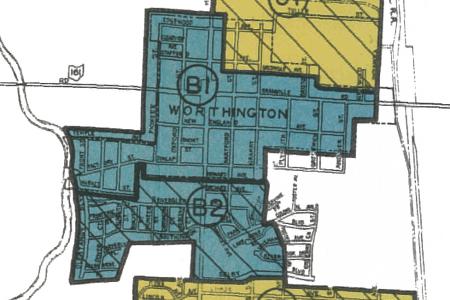
The term "redlining" stems from a series of "residential security maps" of more than 200 cities, created in the 1930s by the Home Owners' Loan Corporation, meant to indicate the level of security for real estate investments. Different colors designated the percentage of properties in the area eligible for federal mortgage insurance: the most desirable, Type A, were outlined in green. "Still desirable" areas were Type B and outlined in blue. Type C areas were "definitely declining," and were outlined in yellow. Type D neighborhoods, considered "hazardous" for mortgage support, were outlined in red.
The federal government deemed these "redlined" areas completely ineligible for federal mortgage insurance. It's no coincidence that redlined areas were often neighborhoods where Black residents lived.
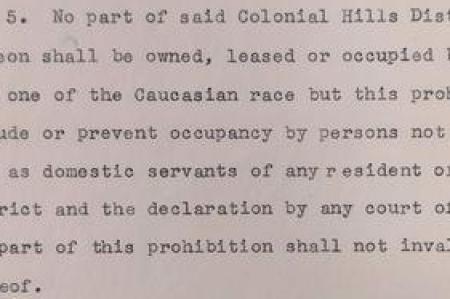
The redlining maps were not the only factor driving racial discrimination in housing. The 1936 map of the Columbus area shows no redlined areas of Worthington, only blue and yellow neighborhoods. However, beginning in the 1920s, new housing developments in Worthington were platted with restrictive covenants, limiting ownership and occupancy of the homes to white residents. An example of a restrictive covenant from the Colonial Hills neighborhood reads:
"No part of said Colonial Hills District or any building thereon shall be owned, leased or occupied by any person other than one of the Caucasian race but this prohibition shall not exclude or prevent occupancy by persons not of the Caucasian race as domestic servants of any resident of said Colonial Hills District and the declaration by any court of the invalidity of any part of this prohibition shall not invalidate the remainder thereof."
This tactic to restrict homeownership was being used all over the country and central Ohio, and Worthington was no exception. In fact, the Federal Housing Administration required racial restrictions for new subdivisions to qualify for federal mortgage insurance. Other neighborhoods developed with restrictive covenants included Riverlea, Detrick Estates and Medick Estates.
Flintridge Terrace, a neighborhood just north of Worthington off of Flint Road, was developed by Black residents who wished to own their own homes but faced discrimination in other neighborhoods throughout central Ohio. In 1958, Robert and Vera Johnson, a Black couple, purchased land to develop the 12-acre neighborhood. As described in "Forward with Brotherhood," a 1969 booklet by the St. John African Methodist Episcopal (AME) Church:
"Mr. Johnson has a master mind for seeing things grow and develop to its full extent. He, being one of our outstanding leaders in Civic affairs, also knew the plight of his Negro Brothers. Suburban property for a Negro to build a new home was almost nil. Unselfishly, Mr. Johnson spent many hours and dollars and had two roads built in Sharon township. Melyers Court and Bertson Place. The Wheatleys [Alexander and Leona] continued the road, Bertson Place. We now have a beautiful area…known as Flint Ridge Terrace."
The 1998 book "Linking Past to Present: An Historical Account of Flintridge Terrace and Its Surrounding Areas" describes the development of the neighborhood:
"Because many of us, as African Americans, had experienced indifferences and sometimes rejections in our early efforts to purchase homes, the aspiration for a beautiful, well-kept neighborhood has been strong. When building issues occurred that threatened to destroy or ‘chip away’ at the security and serenity of the neighborhood, the families stood together and fought back…The Sharon Flint Residents' Association was organized in 1965 to solidify the efforts of the neighborhood, retain legal assistance if needed and to develop and exert political clout when necessary. The first challenge was an effort to change the zoning in the area to allow the construction of a steel fabricating plant…A lawyer was retained and with the support of Flint, Park, and Lazelle Road residents, the request was denied."
In 1963, five years before the passage of the Fair Housing Act, a group of residents in Worthington took matters into their own hands in addressing racial inequality in housing, employment and schooling. Two Worthington residents, Harold Benson Jones and Kent Morehead, called together a group of residents, who formed the Worthington Human Relations Council (WHRC) in 1963.
For the next nearly 30 years, the WHRC worked for equality in housing, schooling, employment and public accommodations. The group assisted Black homebuyers in finding homes in Worthington neighborhoods, and was instrumental in increasing the number of Black teachers hired in Worthington Schools, as well as having Black Studies added to the curriculum in 1970.
A statement given by the WHRC to the Worthington Board of Education in May 1978 rings true today: "If we do not know our neighbors, we all suffer. If we confine our contacts to only those who are identical to us in background, we deny ourselves the opportunity to grow and, in the case of young people, we deny them an important aspect of preparation for life in the larger community of the world."