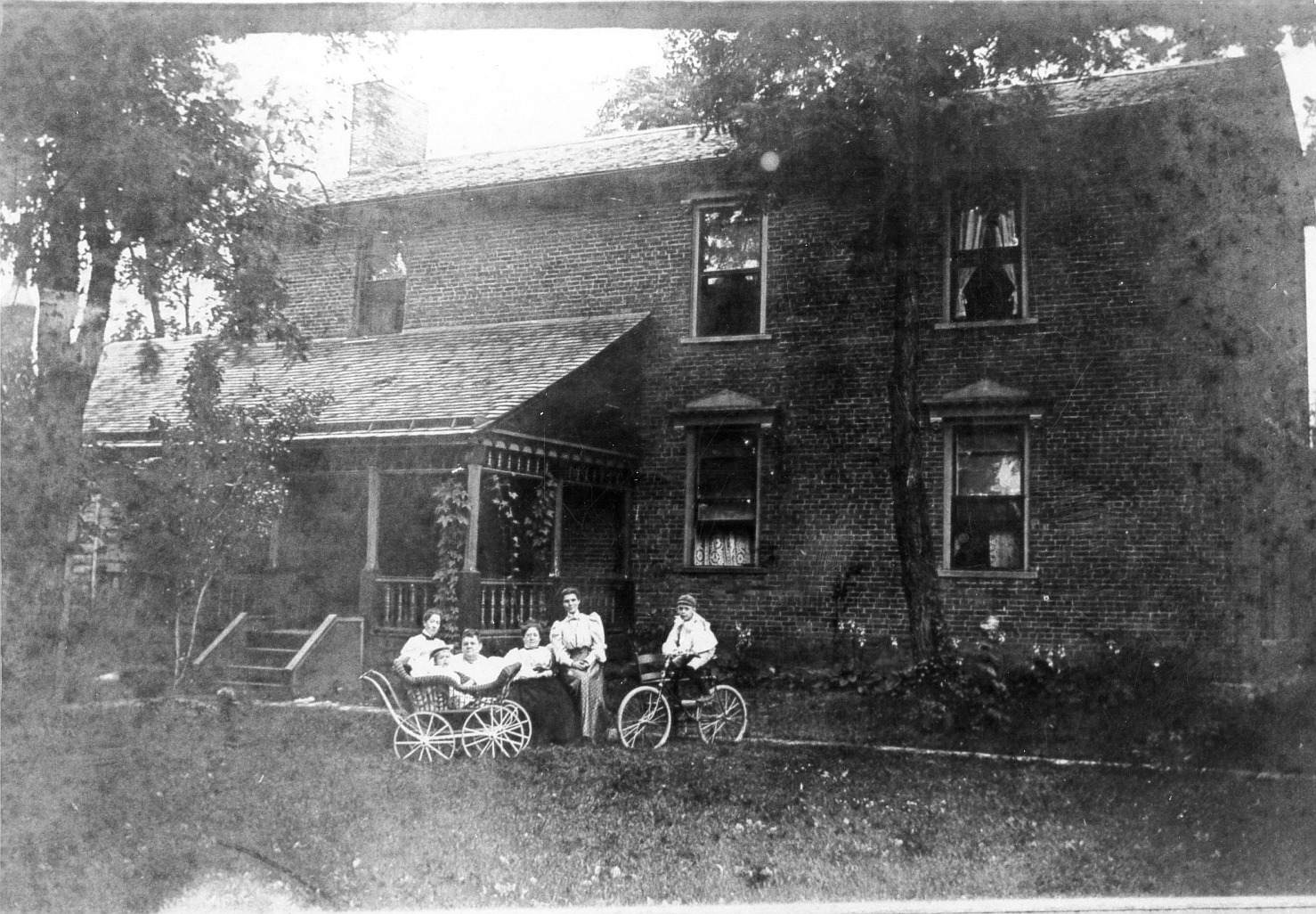
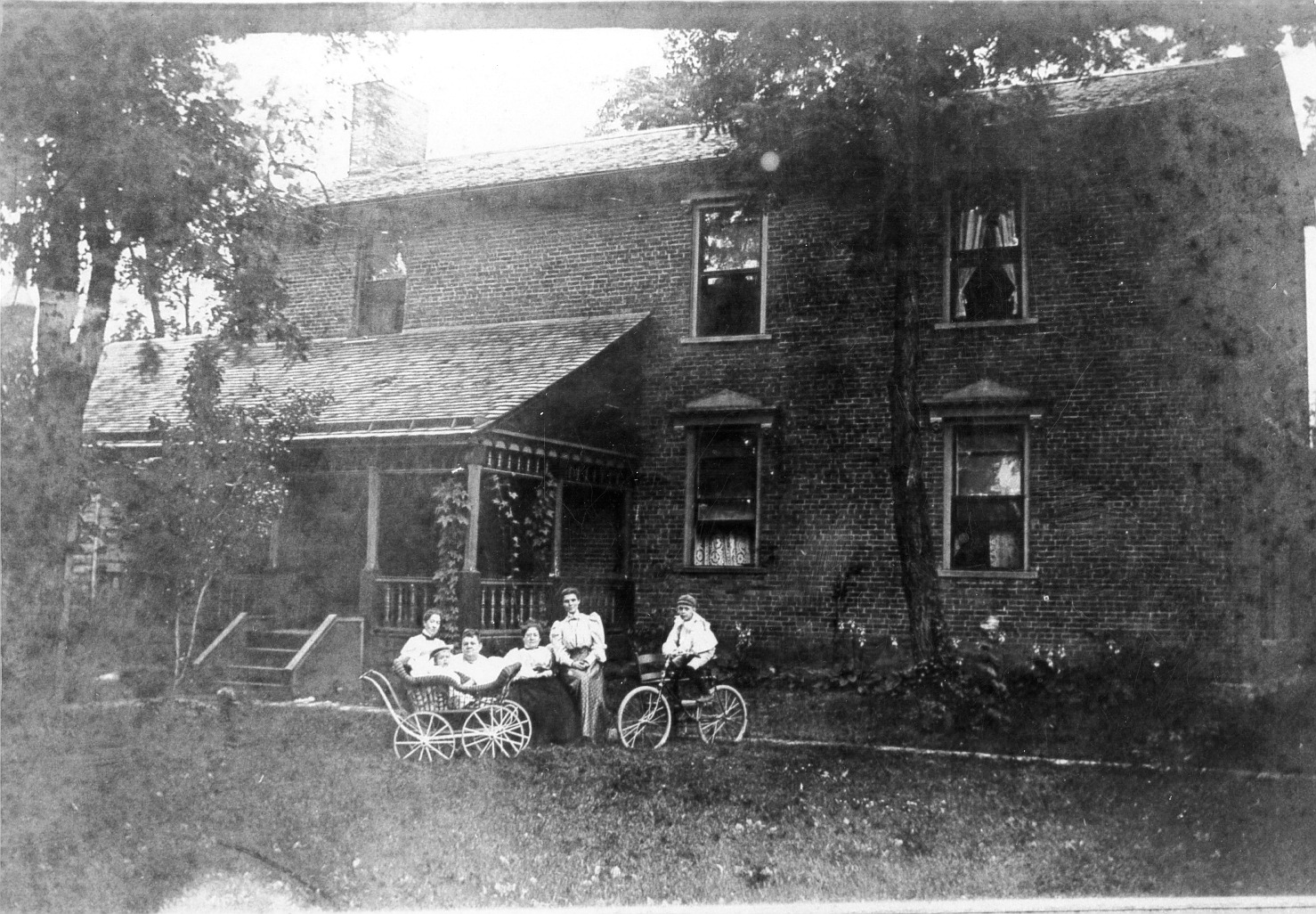
Brown-Weaver family by the Buttles-Pinney-Brown House

Basic details
Background
Members of the Brown-Weaver family are pictured here with a perambulator and bicycle by the Buttles-Pinney-Brown House (a k a Sidney Brown House).
The perambulator was the invention of Charles Burton in America in 1848. He was struck by the fact that:
"Carrying a heavy child in the arms...is not only a wearisome occupation, but often one which...is the cause of serious injuries.." His invention became wildly popular in Great Britain and the United States.
The bicycle was another 19th century invention that vastly improved daily life by providing cheap and easy personal transportation.
The five-bay Federal brick house, located at 12 East Stafford Avenue, was built in 1818 by Arora Buttles. The porch is a later Victorian addition. Its early owners were prominent community leaders: Buttles a mason and builder, Abner Henry Pinney a merchant, Sidney Brown a cooper and grocer. The house is presently occupied by the High Road Gallery, which exclusively exhibits the work of Central Ohio artists.
Subjects
Record details
Copyright

Brown-Weaver family by the Buttles-Pinney-Brown House from the collections of the Worthington Historical Society (WHS) may be used for educational purposes as long as it is not altered in any way and proper credit is given: "Courtesy of the Worthington Historical Society, Worthington, OH." Prior written permission of the WHS is required for any other use of Brown-Weaver family by the Buttles-Pinney-Brown House. Contact WHS at info@worthingtonhistory.org to request permission.